
KH-PRESSE
Interview with Anja Uhlig, founder of Munich’s art space of a different kind:
Das KloHäuschen in Sendling.
By Tabitha Nagy
Munich – Art is not only to be found in spaces created for it, such as exhibition halls, museums or even the chic galleries. It also finds a place and a home in more unusual places. The art space Das KloHäuschen in Munich has been around since 2009. And it is exactly what the name suggests: a former outhouse – urinals included. Artists are invited to work with the space. Anja Uhlig (*1972) founded this space. In this interview with RE:MAGAZINE, she talks about the history and special features of this unusual art space.
Why and how did you start this art space?
Anja Uhlig: I found Das KloHäuschen in 2005. I was new in Sendling, sat in the café across the street and saw the locked door and thought it could possibly be a good studio for me. Then I asked at the wholesale market if I could rent it as a studio – and they told me with a somewhat wrinkled nose, „We don’t think you want to work there“. But they unlocked the door for me – and it was like a miracle: instead of the expected empty room, there was „Das KloHäuschen“! The old urinal with the vanilla yellow tiles and the glass block wall, with the 3 coloured stones. I was in love. And I knew immediately that I wanted to make this room visible to everyone.
When did the space open?
I had a clear vision of how I wanted it to be – in its existing form, I could only open it from the beginning of 2009.
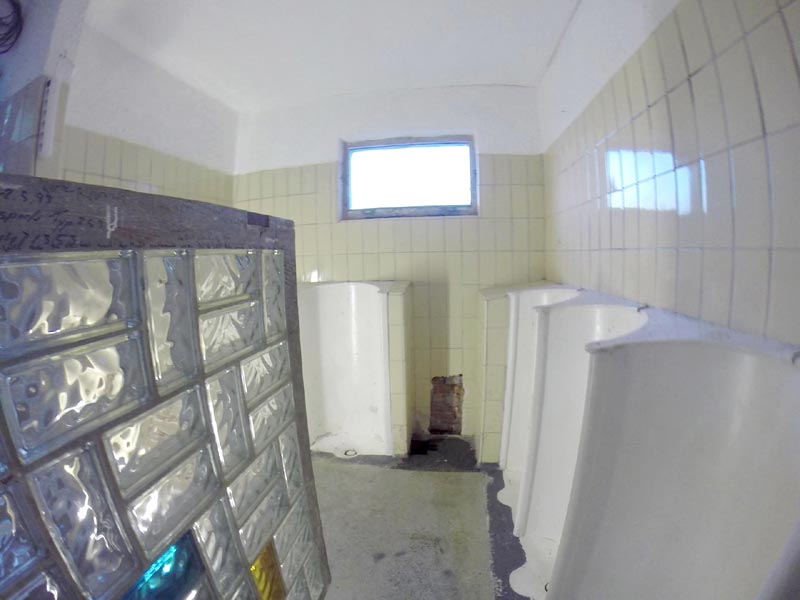
The „naked“ KloHäuschen.
What is the concept behind the space?
With the project „Maßnahmen zur Beseelung des Klohäuschens an der Großmarkthalle“ (engl.: „Arrangements to ensoul the old public toilet at Munich’s wholesale market“) I invite guests to see Das KloHäuschen in its natural beauty, to recognise it in interaction with their own work and to make a completely new situation visible together. This is never about „exhibiting“ objects or „showing“ artists, but always about getting in touch with the space, working with it and letting something emerge together that neither of them (neither our guest nor Das KloHäuschen) could do alone. What is essential is that these 8 square metres do not have to be „useful“ for anything – so it is always about a free artistic work.
To date (early 2021), 114 guests have realised their own work with Das KloHäuschen. In addition, several „festivals“ or community events have taken place, such as the „KloHäuschen Winter Performance Festival“ in the beginning (2011) or the „KloHäuschen Biennale“ since 2012 (which of course takes place every 2 years, and since 2018, even has its own website: www.KH-Biennale.world).
„Collaboration“ instead of „exhibition“;
For the art field it is somewhat unusual […]
to „collaborate“ with the space like this.
Anja Uhlig, founder of the KloHäuschen
What is unique about the art space/project?
Well, the unique thing – in addition to the place itself – is the fact that Das KloHäuschen does not have to be „useful“ anymore not even for „showing art“. So it’s free to create something completely new, without having to achieve any other goal. Working with Das KloHäuschen is always about the free collaboration with the space. „Collaboration“ instead of „exhibition“- it is somewhat unusual for the art field that one does not „exhibit“ one’s work, but is invited to really „collaborate“ with the space. So it’s always about both – about our guest and about Das KloHäuschen. This changes the perspective a bit, there is a lot of freedom – but it can also be a challenge.
Overall, this affects everything, including the organisation and the entire artistic approach. So there are no fixed guidelines as to who does what and for how long with Das KloHäuschen. I discuss this with each guest individually and try to find the way that fits best in each specific situation, for the guest and for the overall project. In this way, the work usually emerges in the process and in dialogue between our guest and Das KloHäuschen – and with me as the „mediator“.
Das KloHäuschen used to be part of the public space. How is it connected to it now?
It is important to me to work with Das KloHäuschen as a part of the public space. It is always visible – and therefore really accessible to anyone who wants it. This can be an opportunity and a challenge at the same time – both for the artists, and sometimes for the visitors.
What kind of program does the art space have?
As I said, it’s never about simply „showing“ artists – it’s always about cooperation, about working with Das KloHäuschen. Then again, a lot is possible and it is very exciting for me personally that on the one hand I am able to get to know such interesting people, diverse artistic positions and works – and at the same time I have been able to see Das KloHäuschen in a completely new way more than 100 times.
Whoever feels like working with Das KloHäuschen – and is able to do that – is invited to be our guest. Most of the guests are contemporary visual artists – but they can also be other people – we have worked with architects, scientists, musicians, gallery owners, theatre makers, activists … It is also important to me that I myself feel like exchanging ideas with my guest.
Normally we first meet on site, I introduce Das KloHäuschen – and we have a coffee together. And then the work develops, sometimes slowly, sometimes quickly. Sometimes I ask someone who I would like to work with. Sometimes someone approaches me. So there are different ways in which we find each other. I even did an international call for artistic proposals once. Some of these have developed into long-term collaborations.
Does this mean, Das KloHäuchen never hosts traditional exhibitions?
There is one exception: Das KloHäuschen Biennale, which has been taking place since 2012. Here, Das KloHäuschen really does consciously turn itself into an „exhibition space“ and in doing so also questions what it needs to become such. It hires a curator who invites the artists – and there is „art mediation“ and a catalogue – in other words, everything you need for a major international art-event – from KloHäuschen’s perspective.
What are the challenges for this artspace?
8 square metres in Munich that are not economically oriented – an old urinal that no longer has to be useful – and that is loved the way it is and doesn’t have to be anything else or better. Especially in expensive Munich, we are used to everything always requiring a purpose, if it’s not an economic one than it must be for social benefit or similar.
So perhaps the challenge is to continuously ask the question „what do you think happens when you put aside the widely accepted idea that everything somehow has to fulfil a purpose?“
What has been the most unusual project in the art space so far?
Hm, hard to say after more than 100 projects that have worked very uniquely with the space. Das KloHäuschen for example was a sloth cage, a holiday flat, a kitchen studio, a grotto, a forest (once with fireflies, once with thunderstorms), a lecture hall, a recreation area, a laboratory, a bumblebee chamber, a Portuguese tavern, a sacred space, and once it was even the Bulgarian pavilion at the Venice Biennale.
It should also be mentioned that Das KloHäuschen has recorded a vinyl record together with the band 9Volt and became a movie star in a film by Mediendienst Leistungshölle. And two jewellery collections have already been designed for Das KloHäuschen.
In addition, the KloHäuschen Biennale has continued to expand in recent years. In 2020 for KHBi5 – the 5th KloHäuschen Biennale, Das KloHäuschen built its own art hall and showed over 60 artistic positions in it.
Memorable moments can also happen unplanned. Unexpected personalities can add special color to the events and even the weather plays its part. We have spent very memorable evenings with rain or snow.
What do you like about the Munich art scene?
For Das KloHäuschen, Munich is perfect. It makes sense here, because in this city, where land is so expensive, almost every square centimetre is „used“ and has to generate income to be allowed to be there. To take about 8 square metres out of this „use“ (without pursuing other goals, pedagogical, integrative or anything else politically correct) is on the one hand pure luxury, but on the other hand absolutely necessary from my point of view. And I’m always happy to see that there are people in Munich who see it that way as well and choose to be part of it. As guests, collaborators or even simply as visitors.
What is the last exhibition or artwork you saw (virtually or otherwise) that impressed you?
I have been working with Munich-based artist Alexeij Sagerer for more than 10 years now and his work never fails to impress, surprise, delight and inspire me. And he has always been progressive, working with internet/online formats as early as 1997, for example. His latest full-length work (not an internet work this time) is „Liebe mich! Wiederhole mich!“ (engl: „Love me! Repeat me!“) – the film can be seen here: www.proT.de).
And for sure, the most recent KloHäuschen guests come into my mind: Uwe Jonas, Stephanie movall, Patricia Wich, Martina Kändler, Albert Coers, Veronika Veit (as of March 2021). Both their works and my exchanges with them, were exciting and impressive.
(…)
Which artists, curators or other people from the art world and their work do you recommend to the readers?
Of course, previous KloHäuschen guests, because the closer I get to their work, the more each one fascinates me in their often very different approaches.
And last but not least, Marcel Duchamp. Das KloHäuschen simply has to like him. Not just because of the toilet, but because of his humour (see „Conversations with Marcel Duchamp“).

ENGLISH TEXTS
We hope, most parts of The KloHäuschen page can be roughly translated by your Browser’s translation function.
But we are happy to provide you some carefully translated texts as well:
by Tabitha Nagy, 2021
KH #010

